Nightmare
You Should Have LeftNightmare is not a contained bad dream but a recurring state that invades the narrator’s waking life and makes the mountain house impossible to interpret securely. It begins after an unusually happy family evening and develops through repeated images, bodily terror, spatial distortions, and apparent evidence that the dream continues after awakening. The decisive horror is not simply the presence of the narrow-eyed woman; it is the collapse of the boundary by which the narrator distinguishes sleeping from waking, imagination from matter, and safety inside the house from danger outside it.
Origin and Initial Image
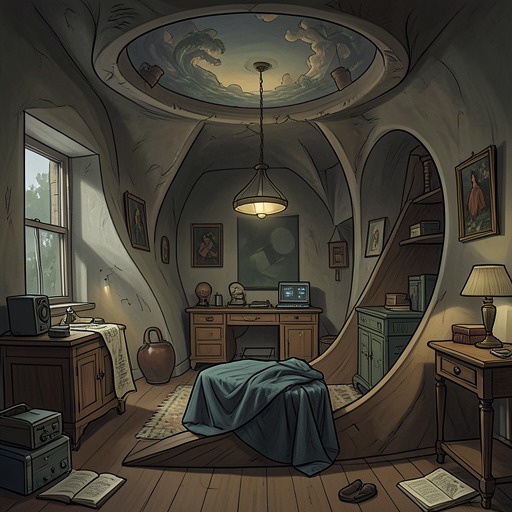
The first nightmare follows an evening the narrator considers the best he has experienced in a long time. He puts Esther to bed, reads her a picture book about a mouse that discovers the moon is made of cheese, eats the moon, and finds it still present afterward. The absurdity delights Esther, and her pleasure gives the narrator a moment of uncomplicated tenderness. Once she is asleep, however, the domestic scene is replaced by an empty room with a naked lightbulb, a three-legged chair whose fourth leg has broken away, and a locked door. The room has no apparent cause for fear, yet the locked door makes the narrator ask what he was afraid of, turning the absence of an external threat into the first threat itself.
The woman who appears in this room is described through unsettling physical particulars rather than through a known identity. Her narrow eyes are set close together beside the root of her nose, which bears a deep central wrinkle; her forehead is wrinkled, and her slightly open lips reveal yellowish teeth like those of a heavy smoker. The narrator insists that her eyes are the terrible feature. As she stands before him, his fear becomes physically overwhelming: he trembles, struggles to breathe, his eyes water, and his legs weaken. He attempts to separate dream experience from bodily experience by observing that his real body is not undergoing these reactions, but the distinction fails. The fear is as real as fear can be, and only when the woman steps back does he return to the bedroom, where Susanna is breathing steadily and the baby monitor shows Esther asleep.
Repetition and Escalation
The nightmare acquires a material explanation when the narrator recognizes the woman from a photograph on the wall of the laundry room, positioned beside the Miele washing machine and dryer. This discovery briefly places the image within ordinary memory: perhaps the dream is merely an excessive response to something seen in the house. Yet the explanation is too weak to neutralize the recurrence. The house has already produced small disturbances, including the family’s getting lost on the way to the bedroom and a vacuum cleaner crashing down in the storeroom without waking Esther. Susanna calls such incidents slapstick and says that things have a life of their own, while the narrator rejects that comic interpretation. The nightmare develops in the same unstable zone, where an apparently trivial object can become the source of a terror that no rational account fully contains.
On the next night the empty room returns, but its details cannot remain fixed. The narrator first sees a small barred window and then corrects himself: there is no window. The broken chair remains in the corner, while the narrow-eyed woman briefly becomes Susanna before changing back. The narrator runs through a corridor, cannot find the light switch, and thinks that a dream does not require light. His purpose is reduced to escape, repeated internally as an urgent command to get away, while he tries not to look at the woman beside him. When he finally opens the front door, he feels grass beneath his bare feet and wind striking his face so painfully that he wakes.
The awakening does not end the experience. Susanna lies beside him, and the monitor shows Esther sitting up and staring into the camera with gleaming white eyes. At the same time, the narrator still feels grass on his feet and wind on his face. He is in bed and outside the house simultaneously, groping for a door handle that has clicked shut and left him locked out. The episode makes the nightmare a spatial condition rather than a sequence of images. He tries to restore ordinary logic by getting out of bed, running down the corridor, and searching for a light switch, but even the supposedly waking house remains dangerous: the staircase railing is too low, the cold seems capable of killing him, and the door cannot be opened because it would force him to look at himself from both inside and outside.
Reality, Evidence, and the House
The narrator’s response is marked by contradiction. He knows that, in films, a character may discover that frightening events were only a dream, a device he has used in his own work, including Lola and Uncle. Yet he declares that a person who is awake knows that he is awake and that nobody seriously asks whether waking life is a dream. He therefore records both assertions: he knows he was not dreaming, but he must have been dreaming. The nightmare’s power lies in making incompatible explanations coexist without allowing one to settle the matter.
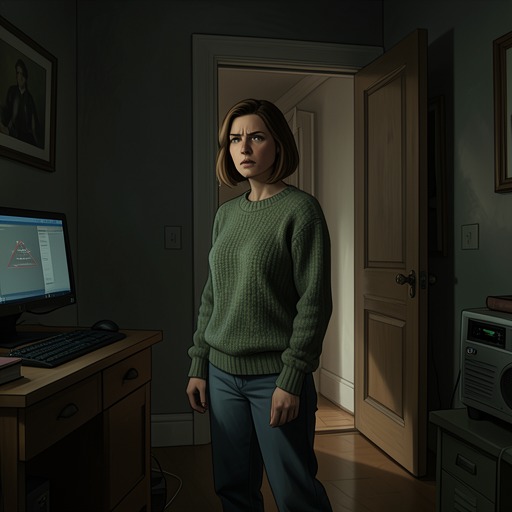
Susanna independently reports that something is wrong with the house. She describes an atmosphere that feels abnormal, poor sleep, and feverish dreams of the unusual kind in which she and the narrator occupy a small room together. Her testimony prevents the narrator’s experiences from being dismissed as a private weakness or an isolated reaction to the photograph. The house becomes a shared source of disturbance, although the family does not possess a shared language for explaining it. Domestic interruptions continue to complicate the attempt to investigate: Esther’s care, dinner, bathing, and bedtime remain necessary, while even the bathtub seems spatially unreliable when the faucet appears farther away than its visible position permits.
The baby monitor provides the most disturbing apparent evidence. The narrator hears a high humanlike voice forming incomprehensible, singsong words and discovers that the sound comes from the monitor, although Esther appears to be asleep and alone. When the voice returns, the screen shows a large figure leaning over her bed. The narrator first experiences the image as an intruder, then recognizes that the figure is himself, explained provisionally as a delayed transmission from a minute earlier. The technical explanation briefly restores order, but the image has already produced its effect: Esther sits up, stares at the figure, and screams. The monitor therefore does not simply distinguish reality from hallucination; it reproduces reality with a delay that makes the past appear present and turns the narrator into a threatening double.
Bodily Terror and Narrative Function
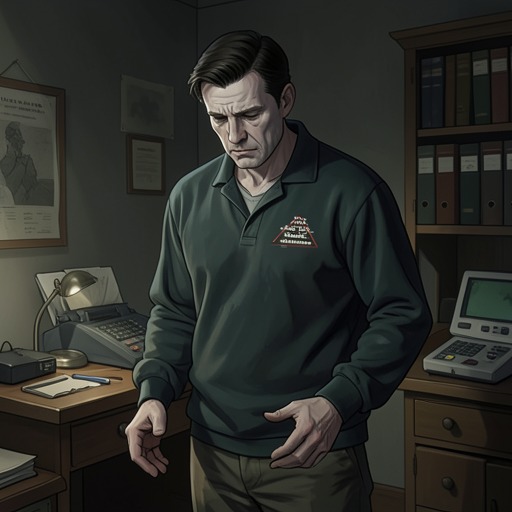
The nightmare repeatedly converts abstract uncertainty into bodily experience. The narrator’s trembling hands, pounding heart, labored breathing, cold skin, and inability to trust his own position prevent the supernatural problem from remaining an intellectual puzzle. Even his written account becomes unstable: he writes rapidly so that he will not go crazy or in case something happens to him, while his handwriting later becomes scrawled and his body remains cold despite being back in bed. The act of writing is an attempt to witness and stabilize events, but it also exposes how little control he has over them.
The imagery of the nightmare echoes the larger movements of the story. A family that has just reached a temporary reconciliation must put Esther to bed before the adults can remain alone; the house’s corridors then make even the route to the bedroom uncertain. The narrator’s professional habit of designing scenes and supplying backstory also fails him. He can analyze the construction of a film and recognize the conventional use of childhood flashbacks, yet he cannot provide a reliable explanatory structure for the dreams or for the house. The nightmare thus attacks the same confidence in sequencing, framing, and interpretation that supports his work as a writer.
Its recurring demand for escape anticipates the later physical ordeal involving Esther. In the dark and cold, the narrator hums London Bridge Is Falling Down and tries to make Esther sing along, but she stops, cries, and must be carried. The childish song, like the mouse’s moon story, briefly offers form to an impossible situation before failing. His muscles tremble, his fingers feel as though they will break, and Esther says that she wants to go home. The nightmare’s language of fear consequently expands into a crisis of parental responsibility: escape is no longer an individual reflex but a decision made while carrying a child through an environment that may be a trap.
The narrator eventually understands the faces of the people associated with the house as the result of what they have seen. He concludes that the place is not evil but a trap, comparable to a crevice that initially seems easy to climb from, until every movement leads deeper. This image gives the nightmare its most durable significance. It does not present fear as a single attack that can be survived and left behind; it describes an environment in which delay, curiosity, and the search for explanation become the very actions that increase entrapment. The nightmare is therefore both a psychological recurrence and the form through which the mountain house teaches its inhabitants that ordinary reality has ceased to be a dependable refuge.